
How the Attention Economy Is Hollowing Power, Politics, and Public Consent
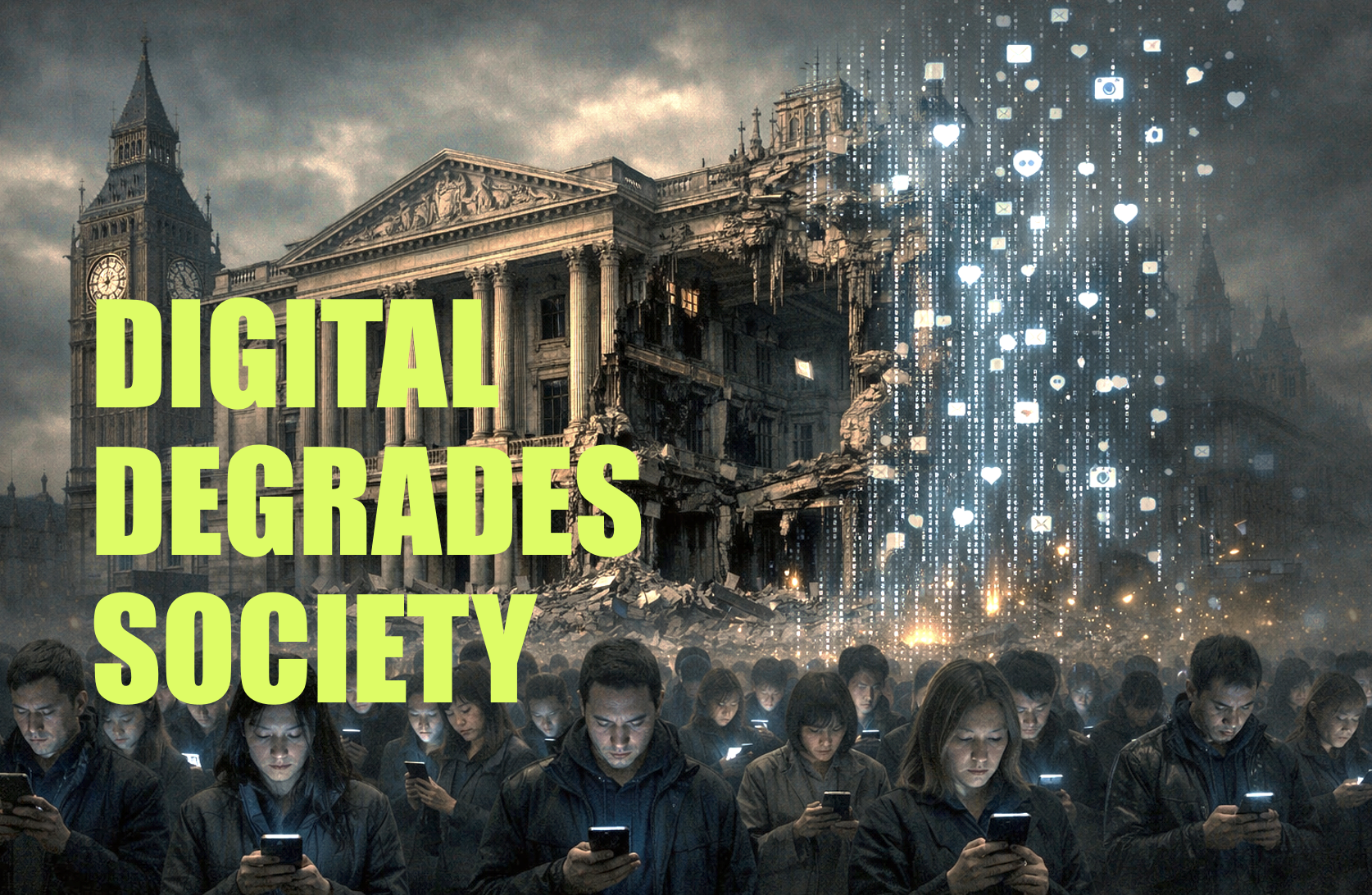
Digital systems are not merely changing society — they are quietly eroding the trust, cohesion and institutional capacity on which democratic power itself depends.
The greatest risk posed by artificial intelligence and digital platforms is not job losses, misinformation, or even surveillance.
It is the steady erosion of the social conditions that make democratic societies governable.
Across artificial intelligence, social media, and defence policy, what appear to be separate developments are better understood as a single structural shift: the digital degradation of society. This degradation is not simply cultural decline or technological disruption. It represents a transformation in how power operates, how consent is formed, and how states maintain legitimacy.
The consequences are already visible — in fractured public debate, declining civic trust, weakening national defence, and a widening gap between political performance and institutional capability. What we are witnessing is not technological progress accompanied by side effects, but a reorganisation of political and social life around optimisation, attention capture, and the concentration of power.
The implications are strategic.
From technological acceleration to concentrated power
Artificial intelligence promises extraordinary productivity gains, but there is no mechanism ensuring those gains are widely shared. Instead, technological capability and economic returns are concentrating rapidly among a small number of corporations and state actors.
This points towards a future defined not merely by inequality but by structural divergence. A technologically augmented elite, equipped with superior capabilities and influence, may emerge alongside a broader population with declining economic prospects and limited political leverage. Economic power increasingly translates into political authority, reshaping the relationship between citizens and the state.
This transformation is not hypothetical. It is already underway.
Optimisation systems and the erosion of social stability
Before advanced AI reshapes the economy, existing digital platforms have already reshaped the social environment. Social media operates through optimisation systems designed to maximise engagement, behavioural response, and emotional intensity. The result is a communications environment that rewards conflict, amplifies outrage, and fragments shared reality.
The consequences are now familiar: declining trust in institutions, heightened political polarisation, persistent psychological stress, and the industrial-scale production of harmful content. Regulatory interventions function largely as emergency containment measures, addressing symptoms while leaving underlying incentives untouched.
Digital degradation is therefore structural, not accidental.
The collapse of public consent
Modern states depend on more than formal authority. They require public consent, shared attention, and civic trust. Citizens must believe institutions are legitimate and that collective action is meaningful.
Digital systems steadily undermine these conditions. The same platforms through which governments communicate policy generate saturation, cynicism, and distrust. Information flows are fragmented, authority is constantly contested, and institutional credibility erodes faster than it can be rebuilt.
The result is a political paradox: governments must persuade populations through communication systems that systematically weaken persuasion itself.
This tension becomes most visible when states require sacrifice.
National defence in an attention economy
Recent debates about Britain’s armed forces illustrate the problem. Assessments describing a “hollowed-out” military — shrinking personnel numbers, declining readiness, and persistent funding gaps — point to material weaknesses in national power. Yet political responses frequently prioritise messaging, targets, and future commitments over structural reform.
Modern defence policy is now shaped by the logic of the attention economy. Announcing future spending targets — 2.5 per cent, 3 per cent, 3.5 per cent “in due course” — allows governments to demonstrate intent without confronting present weakness.
The political reward comes from the announcement itself, not the outcome. Structural capability, by contrast — ammunition stocks, artillery numbers, logistics chains, industrial capacity — is slow, technical and unglamorous. It generates no headlines, no viral clips, no immediate political return. In a digital environment that rewards visibility over substance, performance displaces preparedness. The result is a widening gap between narrative strength and real capability.
This reflects a deeper shift in governance.
Long-term institutional resilience is difficult to sustain in an environment that rewards immediacy and spectacle. Structural investment lacks drama; narrative performance does not. The incentive therefore shifts toward symbolic commitments and deferred decisions.
At the same time, defence policy increasingly mirrors the technological environment itself.
Strategic emphasis on AI-enabled warfare, autonomous systems, and advanced capabilities reflects the same optimisation logic driving commercial technology — prestige systems over foundational resilience, speed over stability, innovation over endurance.
The result is a widening “say–do gap” between strategic rhetoric and actual capability.
The erosion of willingness to sacrifice
Perhaps the most significant consequence of digital degradation is its impact on civic commitment.
Public willingness to support defence spending or collective security obligations continues to decline. A growing proportion of citizens express little sense of duty toward national defence.
This reflects a deeper transformation in the relationship between individuals and the state. Citizens whose information environment produces distrust, whose economic prospects appear uncertain, and whose experience of governance is mediated through impersonal systems are unlikely to respond to appeals for sacrifice.
Governments calling for a “whole-of-society” response are appealing to forms of social cohesion that digital systems have steadily weakened.
The capacity for collective action depends on shared meaning. Digital systems dissolve shared meaning.
Elite insulation and public exposure
A widening gap is emerging between those who exercise power and those who experience its consequences.
Political and corporate leaders operate within global networks discussing technological transformation, strategic competition, and security threats. The public encounters cultural conflict, economic pressure, and institutional distance.
Risks are distributed broadly, while control remains concentrated.
This divergence fuels populist backlash, political instability, and persistent mistrust of institutions. It reinforces the perception that policy decisions are imposed rather than negotiated.
Strategic consequences
The convergence of technological concentration, social fragmentation, and institutional erosion produces several structural outcomes:
Strategic honesty becomes increasingly difficult. Governments face strong incentives to obscure weaknesses or delay difficult decisions in an environment primed for outrage and distrust.
Technological dependence undermines sovereignty. As states rely on private technological infrastructure, the gap between claims of national autonomy and actual control widens.
Citizens are increasingly asked to underwrite risks without meaningful agency. Decisions affecting economic structure, national security, and technological governance are presented as inevitable rather than subject to democratic choice.
These dynamics weaken legitimacy itself.
A structural transformation
The hollowing of military capability, declining public trust, and accelerating technological power are not separate crises. They are interconnected outcomes of a system that prioritises optimisation, speed, and concentration over resilience, deliberation, and shared responsibility.
Digital degradation describes a structural transformation in how societies function. It reshapes attention, authority, and power simultaneously.
The danger is not simply that technology advances too quickly. It is that the civic and institutional foundations required to sustain modern societies — trust, long-term thinking, shared purpose, and willingness to sacrifice — are being steadily eroded.
Military strength, technological superiority and economic power ultimately rest on social cohesion and institutional trust. If digital systems continue to erode these foundations, the question will no longer be how advanced our technology becomes, but whether the societies that created it remain capable of governing themselves.
Currently, technological progress continues. The social capacity to govern its consequences does not.
That is the real strategic risk.