
What today’s politicians can learn from yesterday’s warriors
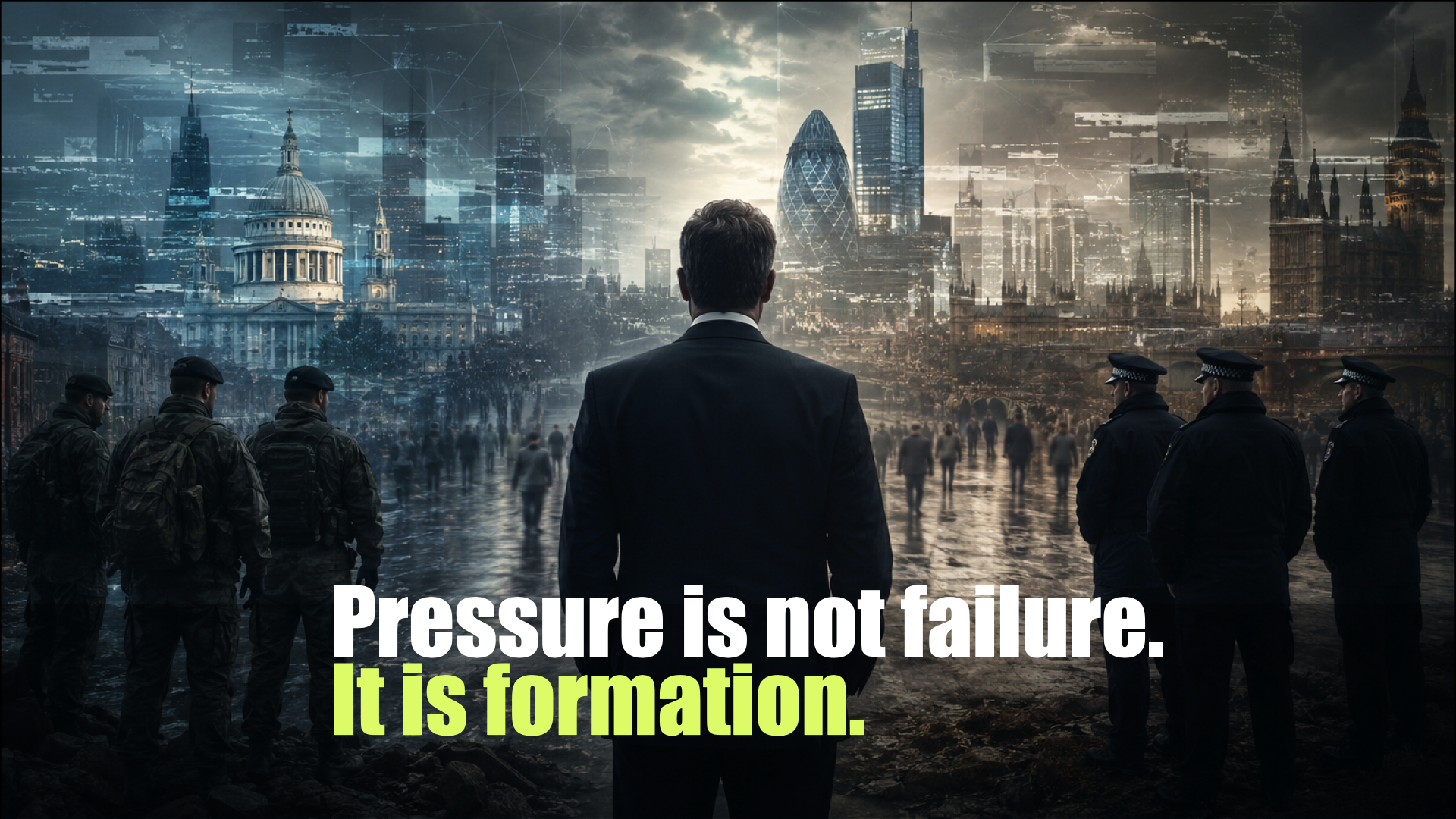
Britain is not ungovernable, as often touted in today’s media.
But Britain is different.
The country now operates amid social fragmentation, algorithmic information environments, demographic pressures, declining institutional trust, fiscal constraint and constitutional tension.
These are not passing disturbances. They are conditions.
Yet much of modern governance still behaves as though stability is normal and disruption is the exception.
Perhaps parts of our institutional culture have become too fragile for the age we inhabit.
Nassim Taleb offers a useful distinction:
Fragile systems break under stress.
Resilient systems withstand stress and return to their original state.
Anti-fragile systems improve because of stress.
That matters because many modern institutions increasingly appear organised around the avoidance of pressure:
Avoid mistakes.
Avoid criticism.
Avoid risk.
Avoid uncertainty.
But pressure is not an anomaly.
It is the environment.
Some of us have been here before.
The Britain of the 1970s faced industrial conflict, inflation, terrorism, constitutional strain and genuine questions about state authority.
In Seasons in the Sun: The Battle for Britain, 1974-79, Dominic Sandbrook wrote that since 1970 Britain had suffered “the most traumatic period in its modern political history, with five states of emergency, two successful miners’ strikes, countless industrial stoppages, the collapse of the government’s authority and the eruption of brutal sectarian anarchy in Northern Ireland.”
Yet the country endured.
Today’s pressures are different.
They are less visible but more diffuse:
Social fragmentation.
Digital information warfare and algorithmic ecosystems.
Demographic pressure and intergenerational strain.
Productivity stagnation.
Declining trust.
Fiscal constraint.
Devolution and constitutional tension.
Stress is no longer episodic.
It is white noise.
Which raises the question: have our institutions adapted accordingly?
Warrior cultures understood this long ago.
The SAS, for example, did not become effective by eliminating uncertainty. It adapted through it.
Nor was this unique to Special Forces.
The RUC during Operation Banner operated for decades amid ambiguity, legal constraint, political pressure, incomplete intelligence and personal danger.
These were not environments of stability.
They were environments of continual adaptation.
This is anti-fragility.
Not surviving pressure.
Learning through it.
There are lessons here for statecraft:
Selection matters:Do not lower standards to fit the candidate. Find and form people capable of operating under pressure.
Mission command matters: People need clarity of purpose, not endless centralised control.
Small teams matter: Large bureaucracies are often slow. Small trusted teams adapt quickly.
Networks matter: Anti-fragile systems do not rely entirely on hierarchy. They build trust, lateral connections and distributed capability. When pressure hits, networks adapt faster than rigid command structures.
Stress is information: Pressure reveals weaknesses in systems, assumptions and leadership. It should not always be treated as a failure. Failure must teach. Anti-fragile cultures turn mistakes into doctrine, training and better judgment.
Character beats process: Forms, compliance and reputation management cannot substitute for courage, discipline and judgement.
Britain does not need, as more people seem to suggest, to become militarised.
But it may need to rediscover some anti-fragile habits long familiar to its warrior cultures: adaptability, decentralisation, mission focus, disciplined initiative, and the understanding that pressure is not always a sign of failure.
Sometimes it is the forge.
The lesson from yesterday’s warriors is not martial.
It is institutional.
Pressure does not automatically mean the system is failing.
Sometimes it is how the system improves.