
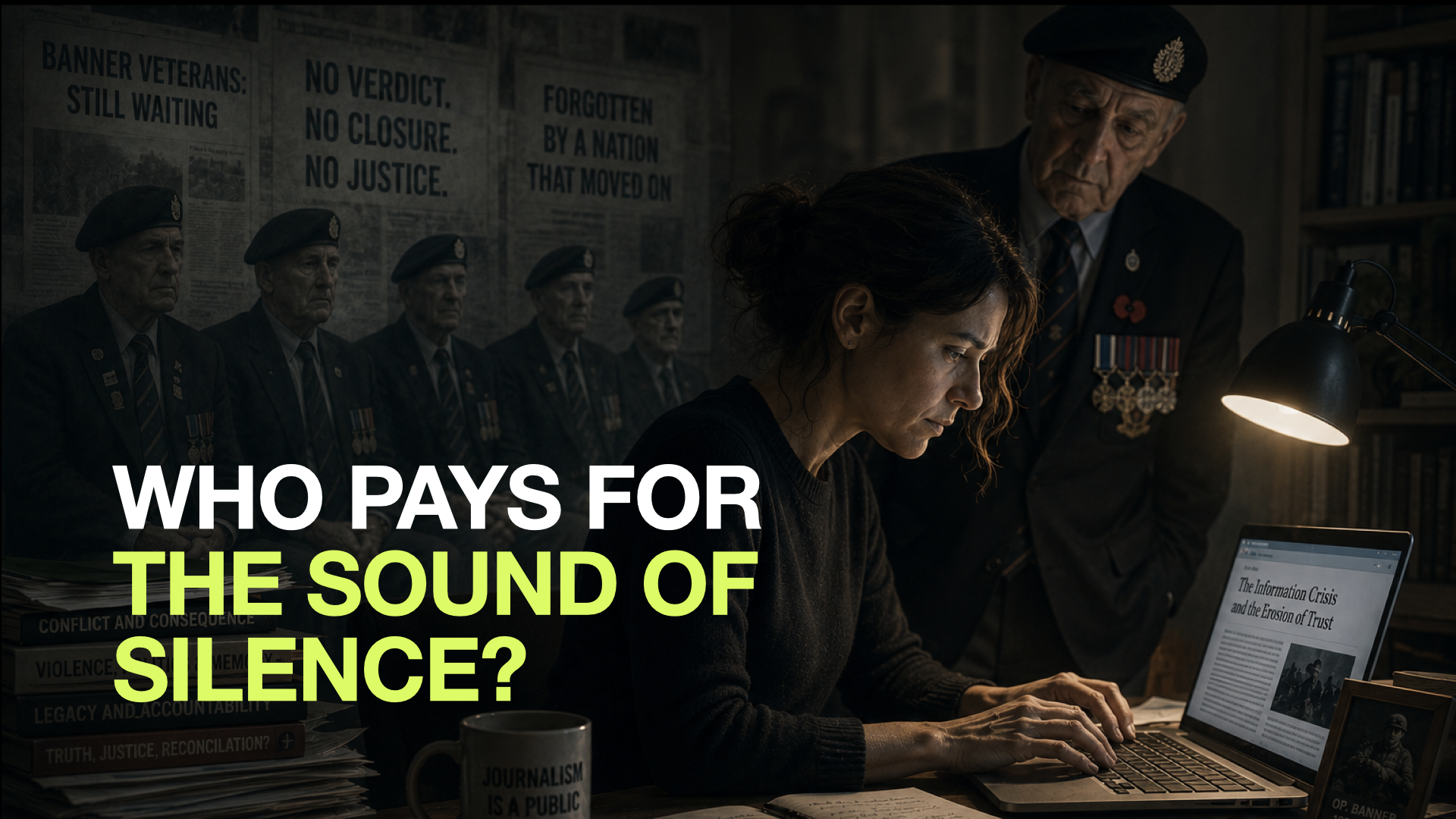
Katharine Viner, Guardian Editor, argues that independent journalism is essential to preserving shared reality in an age of fragmentation and distrust. She is right. But public trust is not eroded by misinformation alone. It also collapses when institutions appear selectively moral, culturally insulated, and unable to see the people left outside their own frame.
There is much in Katharine Viner’s recent Guardian essay, How to survive the information crisis, that reasonable people would agree with.
Eleven years into her editorship, Viner diagnoses our current moment: the erosion of attention, the corrosion of trust, the fragmentation of shared reality, and the role she believes independent, publicly funded journalism must play in holding society together.
Much of her diagnosis is persuasive.
The information environment has plainly become more corrosive. Social media rewards outrage. Technology fragments attention. Public discourse becomes more performative and less reflective. Many people feel isolated, overwhelmed, and increasingly unable to distinguish signal from noise.
But there is a deeper problem running through this kind of commentary, and it is not one of intent.
It is one of distance.
The Problem of Distance
When editors speak of “speaking truth to power”, many readers increasingly wonder: which power?
Because from outside London’s media, political, academic, and NGO circles, large sections of the press — and the Guardian is not exempt from this — often appear less like external critics of the governing culture and more like a constituent part of it, socially and intellectually aligned with the same assumptions, moving in the same circles, instinctively sympathetic to the same causes.
That does not mean journalists are corrupt.
Nor does it mean conspiracies exist.
It means that social class, professional formation, institutional culture, and moral assumptions shape what is considered important, urgent, respectable, or even visible.
And the world looks very different from Leith than it does from Hampstead or Davos.
People living amid economic insecurity, social fragmentation, failing institutions, insecure work, rising crime, and cultural dislocation often do not experience right-wing populism as some inexplicable eruption of irrationality. They experience it as a symptom — sometimes crude, sometimes unhealthy, sometimes dangerous — of a society that no longer appears entirely sure what it stands for.
That does not make populism virtuous or correct.
But dismissing it primarily as manipulation or misinformation avoids the more uncomfortable question of why distrust became so widespread in the first place.
Independence and Conformity
Viner repeatedly suggests that financial independence from proprietors is what safeguards journalistic honesty and courage.
Certainly ownership structures matter. Her contrast with the Washington Post is fair and telling.
But financial independence does not automatically produce intellectual or moral independence.
An outlet can be commercially free and culturally conformist.
A newsroom can be financially independent while remaining intellectually narrow.
A publication can sincerely believe it speaks for ordinary people while largely reflecting the assumptions of a highly educated professional class speaking mostly to itself.
True independence is not merely financial.
It is moral, intellectual, and cultural.
It requires the willingness to notice suffering and injustice even when they fall outside fashionable narratives or institutional comfort zones.
And this is where trust begins to fracture.
The Veterans Question
Which brings us to an absence that deserves to be named directly.
Where was the sustained moral attention — the kind readily applied to miscarriages of justice, institutional failure, or the powerful escaping accountability — when it came to the legal pursuit of ageing veterans from Operation Banner?
Dennis Hutchings, a former Life Guards soldier in his late seventies and gravely ill with kidney disease, was prosecuted decades after a 1974 shooting in South Armagh. He maintained he had fired warning shots. The court sat only three days a week so he could undergo dialysis between hearings. He died in 2021 in a Belfast hospital, mid-trial, still without a verdict, having spent his final years fighting a prosecution while terminally ill.
Soldier F, charged in relation to Bloody Sunday, has spent years inside a grinding cycle of charges dropped and reinstated through legal challenge, trapped in prolonged uncertainty stretching into old age.
These are not simple cases, and it would be dishonest to present them as such.
David Holden, a former Grenadier Guardsman, was convicted in the Aidan McAnespie case and received a suspended sentence in 2023 after the court rejected his account of events. McAnespie was unarmed and shot in the back while travelling to a GAA match. His family’s grief and pursuit of accountability were entirely legitimate.
Complexity acknowledged, the deeper question remains.
Holden was eighteen years old when the shooting occurred — a teenager in uniform policing one of the most dangerous borders in Europe inside a chain of command whose senior political and military architects have faced no equivalent reckoning.
Meanwhile, paramilitaries responsible for bombings, shootings, torture, and sectarian murder across three decades of conflict largely walked free under the terms of the Good Friday Agreement, many after serving only a fraction of their sentences.
The asymmetry is stark.
The individual soldier, acting as an agent of the state, bears the enduring weight of legal and moral scrutiny decades later, while many of those who shaped, directed, or prolonged the conflict — across multiple institutions and organisations — remain politically rehabilitated, insulated, or untouched.
When Process Becomes Punishment
This is the pattern sustained investigative journalism might have examined with the same moral energy it readily applies elsewhere.
Not to excuse every action taken during a dirty war.
Not to claim soldiers are beyond accountability.
Not to deny legitimate grievances or suffering.
But to ask, seriously and rigorously, whether young men sent into an extraordinarily violent and morally ambiguous conflict — under political direction, inside imperfect institutions, within legal frameworks that have since fundamentally changed — are best understood as simplistic moral caricatures or as something considerably more human than that.
That unresolved question now sits at the centre of British politics.
And the way it is being handled deserves scrutiny of its own.
Labour MP Fred Thomas recently identified something veterans have been saying for years: that the central issue is not merely fear of conviction, but fear of spending years defending oneself in court — the investigation, the uncertainty, the reputational damage, the financial strain, and the psychological burden of having events from half a century ago reopened under entirely different legal and political conditions.
Process, in other words, has become the punishment.
The Government’s language around the 2023 Legacy Act has also shifted noticeably over time.
First the Act was described as illegal.
Then unlawful.
Then non-compliant.
Now increasingly, it is described as unworkable.
These are not synonyms.
They carry different legal weight, different moral implications, and different political consequences.
After the Dillon ruling, in which the Supreme Court’s objections proved considerably narrower than much of the public rhetoric had implied — focused particularly on immunity arrangements and procedural restrictions rather than the entire architecture of the legislation — claims of wholesale illegality became more difficult to sustain.
The language shifted accordingly.
“Unworkable” is politically useful precisely because it is harder to challenge than a legal claim.
Which raises a reasonable question.
If elements of the framework were flawed, why could they not have been amended? If immunity provisions required revision, Parliament could revise them. If oversight mechanisms required strengthening, they could be strengthened.
Instead, veterans were effectively asked to accept the removal of existing protections first while trusting that revised safeguards would emerge later through the political process.
To many ageing former soldiers, police officers, and intelligence personnel, that sequence does not feel stabilising.
It feels familiar.
Selective Visibility
None of this means there should be immunity from wrongdoing.
The Holden case alone demonstrates that accountability remains an important principle within the rule of law.
But there is a widening gap between accountability and perpetuity.
Between justice and endless process.
Between legitimate scrutiny and institutionalised legal uncertainty.
That gap is precisely where trust collapses.
And it is precisely where genuinely independent journalism — the kind Viner describes, willing to pursue the powerful and attentive to those who feel unseen — ought to be doing its most important work.
People notice which questions get asked with urgency and which are quietly set aside.
They notice which institutional failures attract sustained investigative attention and which become politically awkward.
They notice which groups are granted moral complexity and which are reduced to their role within a pre-existing narrative.
And once people begin to feel selectively unseen, arguments about shared reality, civic trust, and the vital importance of journalism become considerably harder to hear.
The problem is not that Viner is wrong about what journalism should be.
The problem is the growing gap between that ideal and what large sections of institutional journalism too often appear to be.
And no ownership structure, however enlightened, can close that gap on its own.