
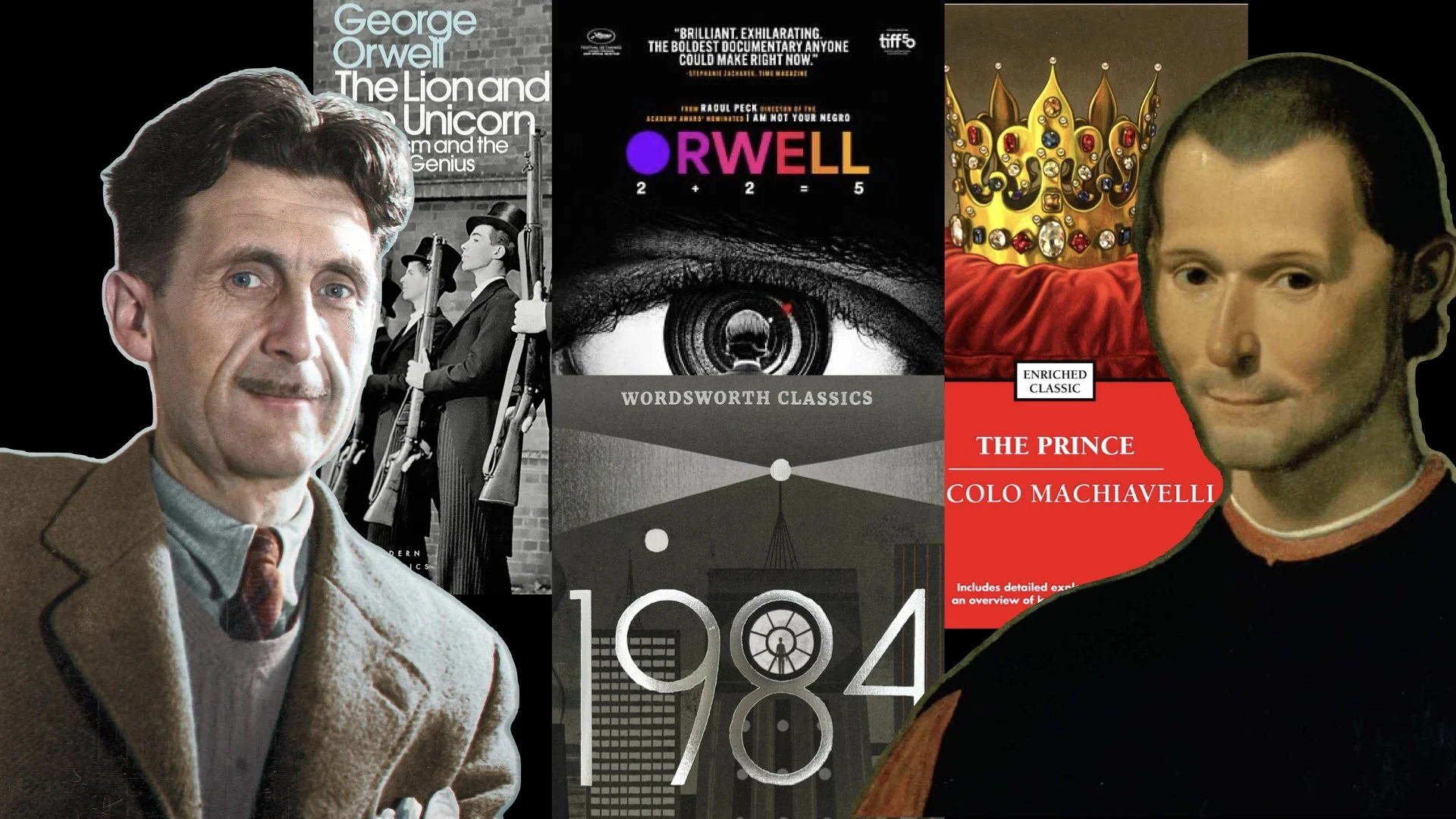
I’ve recently found myself returning to two writers who seem to hover over Northern Ireland politics whenever the atmosphere thickens: Orwell and Machiavelli.
The timing has been sharpened by watching the newly released documentary Orwell: 2+2=5, while also reading Jonathan Powell’s The New Machiavelli and Orwell’s The Lion and the Unicorn. Taken together, they offer a useful lens on a political culture in which truth, power, identity, and performance are rarely far apart.
Northern Ireland is a prime example of a place where politics is read not just through policy, but through signals.
What is said often matters less than what is implied, and what is omitted can matter more than what is announced.
That is why Orwell remains so useful here. He understood how language can be bent until it conceals rather than clarifies, and how political systems can drift into euphemism, ritual, and managed reality. In Northern Ireland, where trust in institutions has so often been fragile, that warning still lands hard.
At the same time, Machiavelli helps explain something else: the relentless logic of leverage.
In a system built around balancing competing identities, consent is often less important than advantage, and stability is frequently achieved not by consensus but by careful calculation.
That can make the politics look cynical, but it is also why it is so durable. Machiavelli would have recognised the choreography immediately: keep your options open, preserve your position, and never underestimate the value of appearing stronger than you are.
That tension — between Orwell’s fear of truth being corrupted and Machiavelli’s acceptance that power must be managed as it is, not as we wish it to be — feels particularly familiar in Northern Ireland.
Every major question here seems to carry both dimensions. Is a statement sincere, or tactical? Is a concession genuine, or merely repositioning? Is an institution being defended, or merely preserved?
Those are very Orwellian questions in their suspicion of language, and very Machiavellian ones in their suspicion of motive.
Orwell’s The Lion and the Unicorn is especially relevant because it shows him thinking not in abstractions, but about how a political order holds together under strain.
That matters in Northern Ireland, where the legitimacy of the settlement is always being tested, whether by constitutional argument, institutional deadlock, or the slow erosion of public confidence.
Orwell’s instinct was that a political community cannot survive on rhetoric alone; it needs a shared reality, however imperfect. Northern Ireland politics often looks like a place where that shared reality is continually under negotiation.
Powell’s The New Machiavelli sits in a different register, but it points to the same hard truth: politics is often shaped by what can be sustained, not by what is ideal.
That may be an uncomfortable lesson, but it is not a useless one. Northern Ireland has never been governed by innocence. It has been governed by endurance, compromise, suspicion, and the constant management of risk.
That is why Orwell and Machiavelli keep coming back.
Orwell explains the anxiety that politics is becoming more deceptive.
Machiavelli explains why it so often succeeds anyway.
In Northern Ireland, where language is always freighted, and power is always conditional, both remain indispensable.
That may be why both men continue to trend, even in places and on issues they never could have imagined.
Orwell helps explain why people feel politically deceived. Machiavelli helps explain why those who deceive often succeed.