
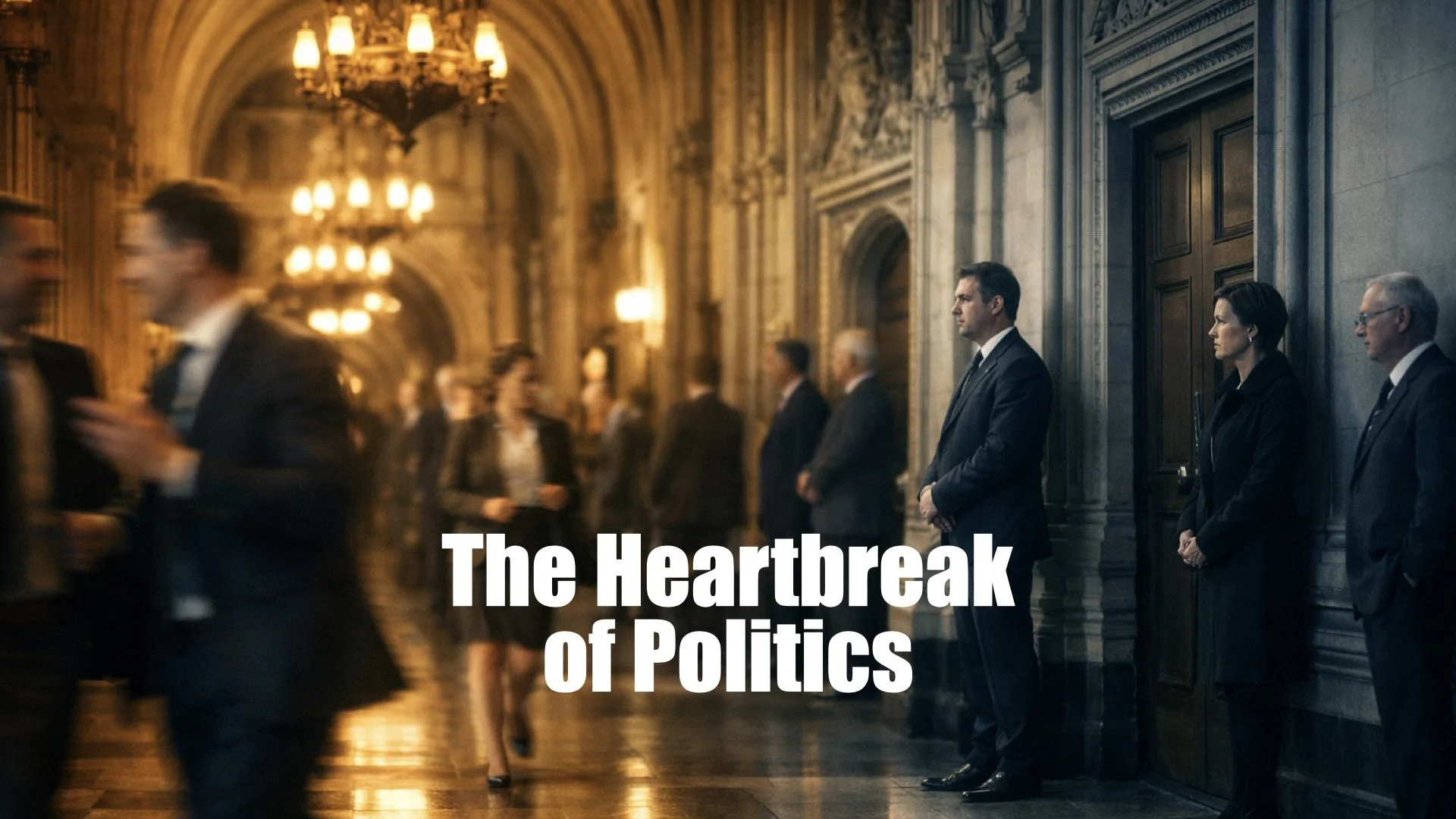
Idealists enter politics hoping to change it. Then, discover something else entirely: a machine that rewards alignment, punishes independence, and quietly reshapes those who stay.
Young idealists still arrive in politics under the influence of The West Wing. They may not know it — and a lot of them have probably never even watched the thing — but they’ve inherited its atmosphere all the same: politics as vocation, government as a proving ground for the gifted, public service as a place where clever, sleep-deprived people in rolled-up sleeves clash over first principles and somehow drag the country, bruised but upright, towards the light.
Then they enter the building.
And what they find is less Aaron Sorkin than estate management. Less soaring rhetoric than message discipline. Less moral drama than career arithmetic. By the time the idealist has sat through their third meeting about wording, positioning, stakeholder reaction and whether now is “the right moment” to say what they actually think, House of Cards starts to feel less like satire than leaked training material.
That is the real political education. The West Wing teaches you why people go in. House of Cards teaches you why so many come out hollow.
The West Wing Delusion
Sorkin’s Washington was politics as liturgy for the meritocratic class. Everybody was brilliant. Everybody was exhausted. Everybody cared. The corridors hummed with intelligence and moral purpose. The state, however flawed, was still imagined as a machine that could respond to reason if only the right people spoke quickly enough and with sufficient sincerity.
It was intoxicating television—and not just metaphorically. Aaron Sorkin has spoken openly about his cocaine use during the early years of The West Wing, which lends the whole thing an unintended clarity. The show moves like a stimulant: fast, confident, certain of its own brilliance. Every idea lands. Every argument wins. Every institution, however strained, still bends—just enough—towards the good.
That is the real fantasy. Not that politics contains good people, but that the system is ultimately responsive to them.
Because in practice, politics does not neutralise itself in the presence of talent. It processes talent. It domesticates it.
The young operator arrives wanting to change things and is immediately taught the hierarchy of what matters: party first, message second, donors and factions somewhere behind the wallpaper, conscience if time permits. The whip does not need to bark very often because everyone understands the grammar of punishment. Defy the line and the consequences are rarely theatrical. You do not get thrown into the Tower. You simply stop mattering. The committee seat goes elsewhere. The promotion evaporates. The invitation does not come. Politics, in real life, is usually too well-mannered to stab you. It prefers to leave you out of the room.
That is why The West Wing is not just unrealistic. It is misleading in a very particular way. It suggests that politics is deformed mainly by the presence of bad men. Quite often it is deformed by systems that make good men manageable.
House of Cards Reality
Frank Underwood, for all his murder and monologues, was recognisable not because politics is full of Shakespearean monsters, but because the show understood something Sorkin did not: power changes the emotional climate long before it commits any obvious crime.
Nobody needs to push a reporter in front of a train. It is enough that everybody understands loyalty is conditional, language is instrumental, and conviction is useful mainly when it can be branded, packaged and deployed without upsetting the coalition. Underwood is melodrama, yes, but the ecosystem around him is familiar. The transaction. The favour. The smile that means “not yet”. The internal calculation behind every public statement. The endless distinction between what can be said in private, what can be said in committee, what can be said on air, and what cannot be said at all.
British politics, if anything, is meaner in a duller way. It lacks the American grandeur, so it compensates with tribal discipline and a certain institutional claustrophobia. The whip system has none of the glamour of congressional arm-twisting; it is simply the daily enforcement of permissible thought. Local party machines do much of their work before the public ever sees a candidate. By the time someone reaches Parliament, most of the rough edges have already been sanded off, or at least taught to present themselves only in private.
And yet the real damage is not done by villainy. It is done by erosion.
A few years in, even decent people begin to sound managerial in the soul. They stop speaking in convictions and start speaking in constraints. They have seen too much casework, too many housing disasters, too many bureaucratic dead ends, too many constituents arriving with problems that cannot be solved by eloquence or indignation. They learn caution not because they are cowards, but because they are tired. That is the great unwritten political drama: not corruption, but depletion.
PMQs, Pantomime and the Public
Meanwhile the public watches the spectacle and draws the obvious conclusion: these people are ridiculous.
Prime Minister’s Questions is one of the great engines of democratic cynicism because it compresses politics into its least serious form and then presents that performance as representative. The braying, the rehearsed contempt, the sixth-form wit, the whole travelling circus of men who look as though they would sell their grandmother for a clip on the evening news. It is politics translated into a language almost designed to repel serious adults.
But the public misunderstanding runs both ways. Voters see pantomime and assume nothing real happens elsewhere. Politicians retreat into the private consolation that the public has no idea how much invisible labour sits beneath the theatre: the casework, the committee papers, the briefings, the local meetings, the impossible social problems delivered one by one into constituency inboxes. Both sides end up despising caricatures of the other. Citizens see frauds; politicians see ingrates. Trust dies in the gap.
And because that gap is now culturally familiar, cynicism passes for insight. To say politics is grubby, compromised, theatrical, emotionally deadening—none of this is especially radical any more. It is common sense. House of Cards won. We are all fluent now in the language of motive, spin, ambition, hypocrisy. We can smell insincerity before the second paragraph. We pride ourselves on not being fooled.
The trouble is that cynicism, once internalised, becomes a form of passivity. If everyone is performative, if every ideal masks an angle, if every institution is merely a racket with stationery, then nothing remains except spectator sport and occasional disgust. We binge the darkness and call it wisdom.
Beyond the Screen
That is where both shows, in their different ways, continue to haunt politics. The West Wing flatters our hunger to believe there might still be adults in charge. House of Cards flatters our suspicion that there are not. One gives us aspiration, the other sophistication. One says the system can still be redeemed by brilliance and decency. The other says the system was always a carcass fought over by predators.
Between them sits the far less cinematic truth: politics as institutional life under pressure, shaped by incentives that reward caution, performance and survival over candour.
You can see the pattern in real time. Figures like Morgan McSweeney are often presented as evidence that politics can be reset from within: sharper operators, clearer thinking, fewer illusions. And for a while, that looks plausible. But over time the role shifts. The reformer becomes the organiser; the organiser becomes the enforcer. Not through betrayal, but through exposure to the same incentives that shape everyone else. What begins as an attempt to change the system settles into the more modest task of running it.
That is not failure. It is absorption.
The real scandal is not that politics contains vanity, cowardice and manipulation. It always has. The real scandal is that we have become so culturally trained to expect either saints or monsters that we barely recognise the slow, grinding manufacture of mediocrity when it is happening in front of us. We talk as though the problem were bad characters, when very often it is the machine itself: the incentives, the tribalism, the rewards for obedience, the penalties for independence, the endless pressure to package rather than to say.
And still, despite everything, some people go in wanting to serve. Some even keep enough of themselves intact to remain recognisably human. Those are not Sorkin heroes, striding down corridors with a moral monologue and a string section behind them. Nor are they Underwoodian schemers licking blood from the knife. They are usually just stubborn people, less glamorous than either myth allows, trying to speak honestly in a world that rewards almost every skill except that one.
That may be the bleakest part of all. Politics does not usually destroy idealists in a single act of betrayal. It teaches them how to live with compromise, then calls that maturity. It teaches them how to perform conviction without risking too much of it. It teaches them the difference between what is true, what is useful, and what is survivable.
Once that lesson is learned, the delusion is over. Not because the idealist has met evil, but because they have finally met the system.