
Why asking the right question matters
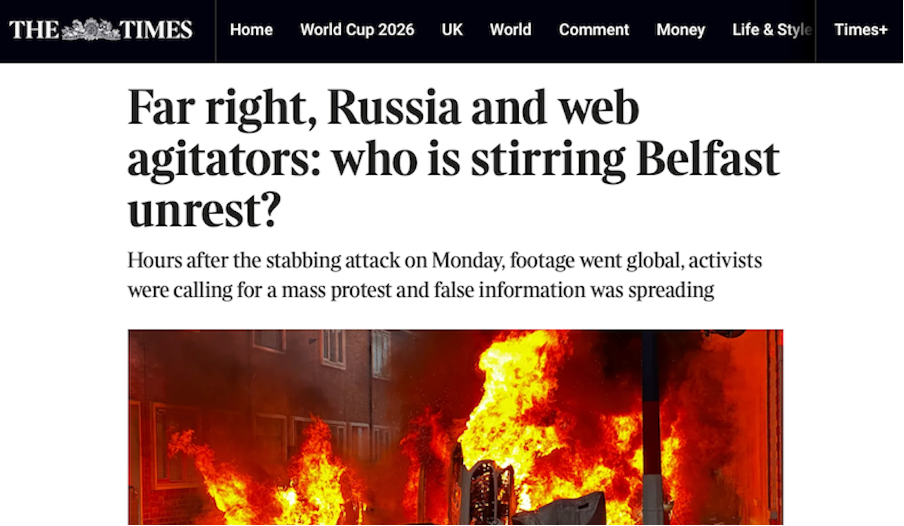
A headline in The Times asks: Far right, Russia and web agitators: who is stirring Belfast unrest?
The article that follows gestures at an answer but never really resolves the headline question. It’s better read as a catalogue of actors and dynamics than a clear attribution of responsibility.
What the article actually shows
It cobbles together documents on how the unrest narrative spread, not definitively who was driving it.
Key mechanisms:
A shocking local incident (the stabbing) produced emotionally potent footage.
That footage was rapidly amplified across networks—local activists, transnational far-right figures, influencers.
Misinformation and framing (e.g. “beheading”, nationality claims, “Islamist attack”) hardened the narrative before facts were established.
Calls to mobilise followed very quickly, including logistics for protests and violence.
That sequence — incident → viral footage → narrative framing → mobilisation — is clear and well evidenced.
Where it falls short
The headline implies a hierarchy of causation (“who is stirring”), but the piece never establishes one. Instead, it presents overlapping categories:
Local agitators
International far-right influencers
Neo-Nazi networks
Politicians
Possible foreign state interest
But it does not:
Weigh their relative influence
Distinguish initiators vs amplifiers vs opportunists
Provide hard evidence of coordination between them
Substantiate the “Russia” angle beyond association and possibility
In fact, it quietly undercuts its own headline near the end by noting there is no strong evidence of primary foreign state direction.
The real answer (implied, not stated)
If you read between the lines, the most defensible conclusion is:
The unrest was locally triggered and locally mobilised
It was rapidly amplified and distorted by transnational online ecosystems
Political and ideological actors then exploited it for their own agendas
So rather than a single “stirrer,” we have a stacked ecosystem:
Ground level: local anger, existing tensions, opportunist organisers
Intermediate layer: UK/Irish activist networks and influencers.
Top layer: global amplification (including high-reach accounts and fringe networks)
On the “Russia” framing
This is the weakest part.
The article:
Mentions Russian-linked actors and symbolic content
Suggests that hostile states benefit from instability
But presents no evidence of operational involvement
That’s a classic media move: introduce a plausible geopolitical actor without proving causation.
It widens the frame but doesn’t answer the question.
A clearer framing
A more accurate headline might have been: “How a Belfast stabbing was weaponised online by local activists, global influencers, and extremist networks”
That reflects what the reporting actually supports.
Think of it less like a centrally directed operation and more like a flash fire:
The stabbing is the spark
Social media is the accelerant
Activists and influencers are the wind
Pre-existing tensions are the dry fuel
No single actor “starts” the firestorm once those conditions exist.
From a research or writing angle, the real story here isn’t “who stirred it” but how rapidly decentralised networks can converge on a narrative and produce real-world disorder without central coordination — which is arguably the more important and underexplored point.
What matters politically is not only who stirred the unrest but also how quickly loosely connected networks can lock onto a single event and convert it into disorder. That only happens where the kindling already exists: unresolved tensions, grievance politics, and communities waiting to be activated.